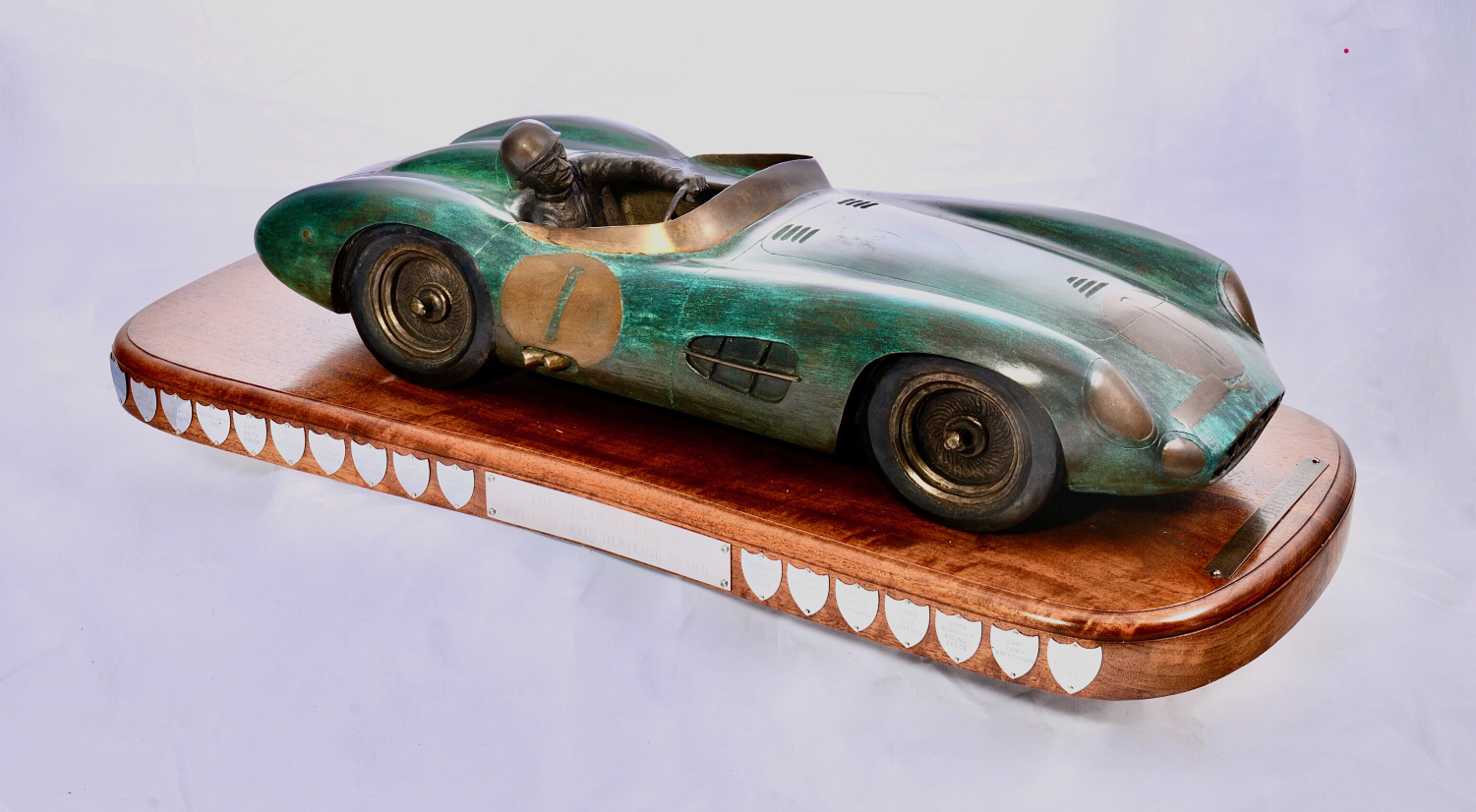
I believe that in relatively recent years John Dawnay, the 11th Viscount Downe, contributed more than anyone to raising the profile of Aston Martin through his various racing efforts and also to the heritage of the marque through both historic racing and his unstinting contribution to our Club the AMOC. The trophy is a fitting tribute to quite a remarkable man. The idea of the trophy came from Diana, the late Viscount’s wife. Richard Williams of RS Williams very generously offered to make the trophy as he had been very much involved with John’s racing program. Richard tells me that the trophy was a specially commissioned bronze casting of a DBR1, which is incredibly heavy and so sits with The Heritage Trust at the barn. Chris d’E. Vallancey of AML Ltd Heritage Operations informs me that recipients receive a much lighter and smaller but no less splendid replica of the original, with the timber base still lovingly crafted by a retired AML Ltd employee, who worked in the wood and veneer workshop. This replica is donated each year by AML Ltd with a small committee submitting names to Lady Downe to consider for the year’s award.
John Christian George Dawnay was born on 18 January 1935, the son of the 10th Viscount and his American wife Margaret Bahnsen; King George V stood sponsor at the christening. He passed away on 15 March 2002 at the comparatively early age of 67. The Irish Viscountcy of Downe was created in 1680 for Sir John Dawnay, who was an MP for Yorkshire and later for Pontefract; several of his successors also sat in the House of Commons.
John was a reserved man, a self-taught scientist and engineer, as well as being a much respected landowner in North Yorkshire and a public figure. He was a multi-talented engineer who was fascinated by mechanical and electronic systems, and one of his creations was the linear circuit design. For those without electronic knowledge, like myself, a simple definition of a linear circuit design is a design in which the values of the electronic components – the resistance, capacitance, inductance, gain, etc. – don’t change with the level of voltage or current in the circuit. Linear circuits are important because they can amplify and process electronic signals without distortion. An example of an electronic device that uses linear circuits is a sound system.
John maintained a private laboratory at the family seat of Wykeham Abbey near Scarborough in North Yorkshire for further developing inventions. Wykeham Abbey was originally the site of a Cistercian convent until Henry VIII dissolved these in the 1530s. The estate passed to a younger son the 4th Viscount Downe from a cousin in 1824. The present house was built in the mid-18th century and was further expanded in the 1830s, possibly by Thomas Henry Wyatt, a respected Anglo-Irish architect with a large number of important churches, houses and public buildings to his name. There were further additions to the house in 1902. The house has been the seat of the Viscounts Downe since 1909 along with the surrounding estate. Like many country houses in England it served as a Red Cross recovery hospital in the First World War and from 1914–1919 more than 1520 soldiers and non-commissioned officers passed through there.
John was educated at Eton and did national service in The Grenadier Guards before going up to Christ Church Oxford to read PPE. He went to work as a non-marine insurance broker at Lloyds. At the same time he was burning the midnight oil founding his first small electronics company. John succeeded his father in 1965 as 11th Viscount and Baron Dawnay of Danby, the later title created in 1897. For those of you overseas I should perhaps explain the hierarchy of British titles. It is King or Queen followed by Duke, Marquis, Earl and then Viscount, following these most important titles is a plethora of lesser titles.
John and his wife Diana took a fresh approach to Wykeham Abbey and the Rembrandt etchings were replaced with more modern works of art and the house given a brighter countenance. The estates, consisting of extensive farmland and forestry around Wykeham and grouse moors at Danby, were also modernised with the addition of an award winning caravan park, fishing lakes and other ventures. John pursued his scientific expertise and became a part time member of the JJ Thompson Physical Laboratory at Reading University.
He was Managing Director and Chairman of Brookdeal Electronics Ltd. He also founded Sintrom, an early pioneering company in fibre optics, as well as founding numerous other companies. He was a director of many companies including George Rowney, the artist’s materials manufacturer. He was a director of The Yorkshire Bank and President for over 30 years of the North York Moors Historic Railway Trust, which still run steam trains from Pickering to Grosmont. He was also Chairman of the National Railway Museum in York and a trustee of the Science Museum in London.
John also served as an independent member of North Riding County Council from 1969–1985. He was President of Yorkshire Rural Community Council, Vice Chairman of North York Moors National Park committee and Chairman of The Derwent Hunt. He was Vice Chairman of the Scarborough Theatre Trust, which raised the funds for Stephen Joseph Theatre-in-the-round. John was also a liveryman of the Company of Scientific Instrument Makers and a member of The Royal Institution. A Freeman of the City of London and Master of the Company of the Staple of England, an ancient guild of cloth merchants. John was also appointed as Deputy Lieutenant of North Yorkshire in 1981 and was honorary Colonel of the 150th Yorkshire Royal Logistics Corps.
In the North of England we have a saying: ‘If you want a job done give it to a busy man’. If any of us achieved 10% of what John did we would consider that we had made some contribution to society. John accomplished more in a week than some of us do in a lifetime. Once you have got your breath back just take stock and consider what he attained in his lifetime, and we haven’t talked about Aston Martins yet.
John acquired his first Aston Martin, a DB2/4, whilst an undergraduate, and later owned and ran some of the most desirable Aston Martins built, as well as other important classic racing cars such as a Ford GT40. He ran the 5.3-litre V8 Nimrod that competed in the 1982 Vingt Quatre Heure du Mans, coming 7th overall and being the first British car home with Mike Salmon and Ray Mallock at the wheel – Network TV produced a film called Nimrod the Mighty Warrior which was aired on BBC TV. Amongst other Astons that he owned were a DBR1 and Project 212. John was a fast driver but as congestion got the better of him he learned to fly and flew his own helicopter and persuaded Diana to do the same. If for no other reason that they could see each other throughout his busy life. John became President of the AMOC in 1980 and remained so until his illness that he eventually succumbed to. Throughout his illness he maintained a cheerful dignity but the illness sadly eroded his ability to communicate. Following John’s sad departure, the AMOC were extremely lucky that Diana followed John’s footsteps in taking over Presidency of the Club.
John was married to Diana Sconce in September 1965, just 3 months before his father died. They had a son Richard, born in 1967, who succeeds to the titles and a daughter Sarah who was born in 1970. I am much indebted to Diana, Lady Downe for her unquestioning assistance in compiling this, I hope fitting, memorial to John, her late husband. The AMOC owes a great debt to both John and Diana for their never ending support. For future recipients of this award you will I hope realise just what you are living up to in receiving this most prestigious of trophies.